


You could have outstanding content, a clean design, and fantastic concepts but if the search engines cannot access and crawl your site, no one will ever find it. That’s what a sitemap generator helps with. In the case of a publishing platform like UploadArticle.com, using a sitemap generator assists search engines in understanding all the pages in a structure they can quickly process.
In simpler terms, a sitemap is like a map of your website. A sitemap is a directory to all significant parts of your website. A sitemap of significant parts of your website would mean each and every page of your website and the link associated with that page, or also to a page that the search engines might not find itself. Well sitemaps mean well indexed and well ranked websites.
In this guide, we explore what a sitemap generator is, why it’s so important, the inner workings behind its functioning, and its benefits over other sitemap creation methods including manually created ones. This has been written with clean and natural language for the purpose of use on your blog, website, or even as a content base for your SEO efforts.
Table of Contents
What Is a Sitemap Generator?
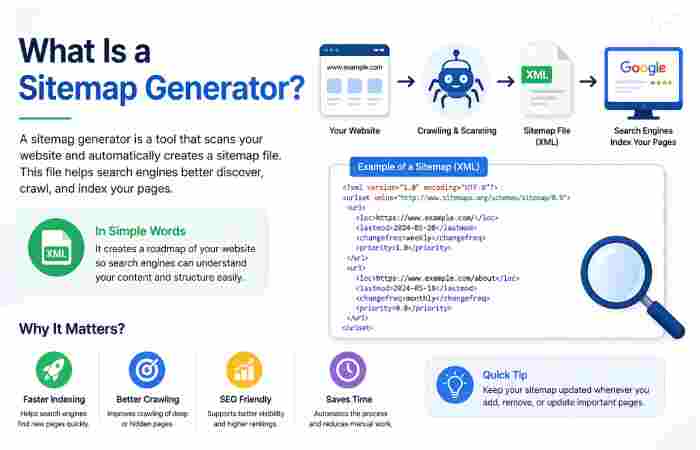
A sitemap generator is an application or website that creates a sitemap file automatically for your website. Generally the most popular sitemap generator will output an XML sitemap that search engines can interpret.
A sitemap generator will not step through the entire site to list all of the individual URLs; instead, a sitemap generator will spider the site to provide a structured sitemap that can hold:
- Blog posts
- Category pages
- Service pages
- Product pages
- Static pages such as About or Contact
- Updated content that should be crawled again
This is important for a content rich, site like UploadArticle.com because articles, edits and category pages may change often, the sitemap generator will streamline the flow and make these easier for search engines to understand.
Why a Sitemap is important for UploadArticle.com
Although a sitemap on its own cannot rank your web page, it does provide a mechanism that enables the site ranking. Search engines function optimally with well structured and discoverable pages. A sitemap simply allows you to simplify this process.
Key benefits include:
- Faster discovery of new pages
- Better crawling of deep or hard-to-find content
- Improved handling of large websites
- More efficient updates when pages are added or edited
- Better support for SEO on content-heavy platforms
If UploadArticle.com publishes many articles, updates categories, or adds internal pages regularly, a sitemap can help maintain order behind the scenes.
How a Sitemap Generator Usually Works
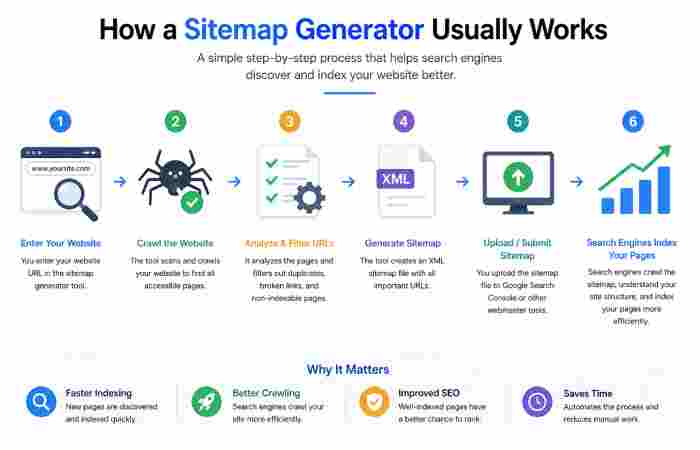
The process is usually simple.
- The generator scans your website.
- It finds all accessible URLs.
- Removes broken or no follow links depending on configuration.
- Create XML sitemap file.
- Sitemap is sent to search engines like Google Search Console and Bing Webmaster tools.
Crawlers crawl through your site based on the sitemap.It means it less effort and chances for you to forget some page.
Definition Table: Sitemap Basics
| Term | Simple Meaning | Why It Matters |
| Sitemap | A list of pages on a website | Helps search engines understand the site structure |
| XML Sitemap | A machine-readable sitemap file | Used mainly by search engines |
| Crawl | The process of scanning website pages | Helps search engines find content |
| Index | A page stored in a search engine database | Needed before a page can appear in search results |
| Sitemap Generator | A tool that creates sitemaps automatically | Saves time and improves consistency |
Comparison Table: Sitemap Generator vs Manual Sitemap vs No Sitemap
| Method | How It Works | Advantages | Limitations | Best For |
| Sitemap Generator | Automatically scans and creates sitemap files | Fast, accurate, scalable, easy to update | Depends on tool quality | Blogs, publishing sites, large websites |
| Manual Sitemap | You build the sitemap yourself | Full control, customized structure | Time-consuming, error-prone | Small sites with few pages |
| No Sitemap | Search engines crawl pages on their own | No setup needed | Important pages may be missed | Very small websites with simple structure |
The table shows a simple truth: a generator is usually the most practical choice for a site that grows over time.
The Need for a Sitemap Generator at UploadArticle.com
UploadArticle.com is one of those websites that thrive on new content, new updates and a vast array of URLs. Hence, managing sitemap would become quite a task if one does not use a Sitemap Generator.
-
Content gets indexed more reliably
When new articles are published, a sitemap gives search engines a direct signal that new content exists.
-
Older content stays visible
If pages are updated, search engines can revisit them more efficiently.
-
Site structure becomes easier to manage
A sitemap helps organize many pages into one clean file.
-
Deep pages are less likely to be ignored
Search engines may overlook pages buried too deep in navigation, but a sitemap helps bring them to attention.
-
SEO teams save time
Instead of manually adding URLs, teams can focus on writing, editing, and optimization.
What Makes a Good Sitemap Generator
Not every sitemap generator performs equally well. A good one should be simple, accurate, and flexible.
A strong sitemap generator usually supports:
- Automatic URL discovery
- Excluding noindex pages
- Handling updated timestamps
- Large websites without slowing down
- Clean XML formatting
- Image or video sitemap support, if needed
- Easy submission to search engines
For a publishing site, update frequency matters a lot. If the generator can refresh regularly, the sitemap stays useful without constant manual effort.
Feature Comparison Table
| Feature | Basic Generator | Better Generator | Why It Matters |
| Automatic URL detection | Limited | Strong | Finds more valid pages |
| Excludes unwanted pages | Basic | Advanced | Prevents clutter |
| Update frequency support | Rare | Common | Keeps sitemap current |
| Large-site handling | Weak | Strong | Useful for growing websites |
| XML validation | Minimal | Better | Reduces errors |
| Search engine compatibility | Standard | Strong | Easier indexing |
This is why many site owners prefer a more advanced generator when the content volume increases.
How to Use a Sitemap Generator for Better SEO
Using the tool is only one part of the process. The results improve when the sitemap is managed carefully.
Good practices include:
- Keep URLs clean and readable
- Remove duplicate pages
- Exclude broken or thin content
- Update the sitemap when major changes happen
- Resubmit the sitemap after large content updates
- Check search console reports for crawl issues
These habits make the sitemap more useful over time.
Common Sitemap Types
A website can have more than one type of sitemap.
| Sitemap Type | Purpose | Example Use |
| XML Sitemap | For search engines | Blog posts, pages, categories |
| HTML Sitemap | For visitors | Human-readable page directory |
| Image Sitemap | For image discovery | Media-heavy content |
| Video Sitemap | For video indexing | Tutorials, embedded videos |
| News Sitemap | For fresh news content | Time-sensitive publications |
For UploadArticle.com, the XML sitemap is the most important starting point. If the platform contains rich media, image or video sitemaps may also be helpful.
Best Practices for Sitemap Structure
A sitemap should not simply be a long list of every possible URL. It should represent the website in a smart, clean way.
A well-structured sitemap usually includes:
- Only indexable pages
- Canonical URLs
- Correct last modified dates
- Priority pages if supported
- A logical split when the site becomes very large
A poor sitemap often includes:
- Redirected URLs
- Duplicate pages
- Noindex pages
- Broken links
- Test or admin pages
Keeping the sitemap clean helps search engines focus on the content that actually matters.
Comparison Table: Clean Sitemap vs Messy Sitemap
| Quality | Clean Sitemap | Messy Sitemap |
| URLs included | Important pages only | Random or duplicate pages |
| Crawl efficiency | High | Low |
| Indexing clarity | Clear | Confusing |
| Maintenance | Easier | Harder |
| SEO value | Better | Weaker |
A clean sitemap is not just tidier. It is also more practical for long-term site growth.
How Sitemap Generators Help Content Publishers
For content publishers, time is always limited. Articles need to be written, edited, published, and promoted. A sitemap generator takes away one repetitive task.
It supports publishers by:
- Detecting newly published pages automatically
- Helping search engines find fresh content faster
- Organizing content by category or section
- Reducing manual SEO work
- Supporting larger editorial workflows
If UploadArticle.com is used as a publishing hub, these advantages can make a real difference.
A Simple Workflow for UploadArticle.com
Here is a practical workflow that works well for many websites:
| Step | Action | Result |
| 1 | Publish or update content | New URL becomes available |
| 2 | Run the sitemap generator | Sitemap file is refreshed |
| 3 | Check for unwanted pages | Keeps sitemap clean |
| 4 | Submit to search engines | Helps discovery |
| 5 | Monitor crawl reports | Finds issues early |
| 6 | Repeat regularly | Maintains SEO health |
This kind of routine keeps your site organized without adding much extra effort.
What Search Engines Like to See
Search engines usually prefer sitemaps that are:
- Accurate
- Updated
- Easy to crawl
- Free from clutter
- Structured around indexable pages
They do not need fancy design. They need clarity. A good sitemap generator provides that clarity with very little friction.
Final Thoughts
Although a sitemap generator seems like a small and technical issue, it can be an significant aspect of a website’s growth. As a website such as UploadArticle.com is likely to see content and pages added and modified frequently, the sitemap assists the search engines in quickly understanding the structure of the website and not missing any of its content.