
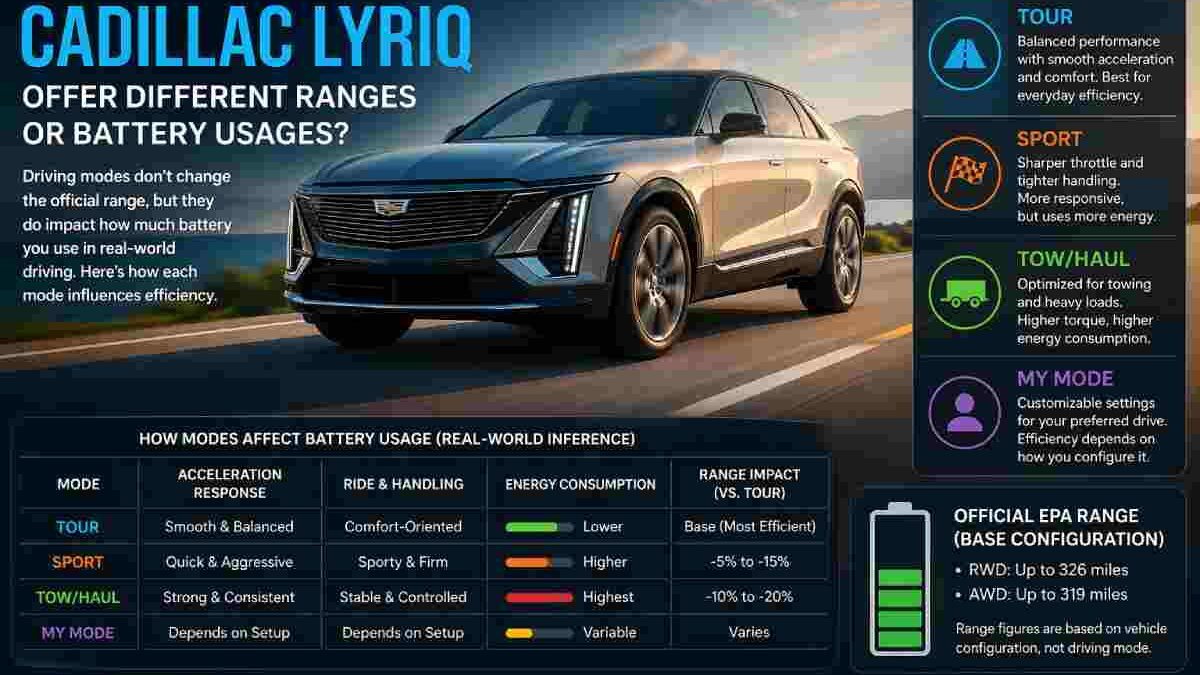
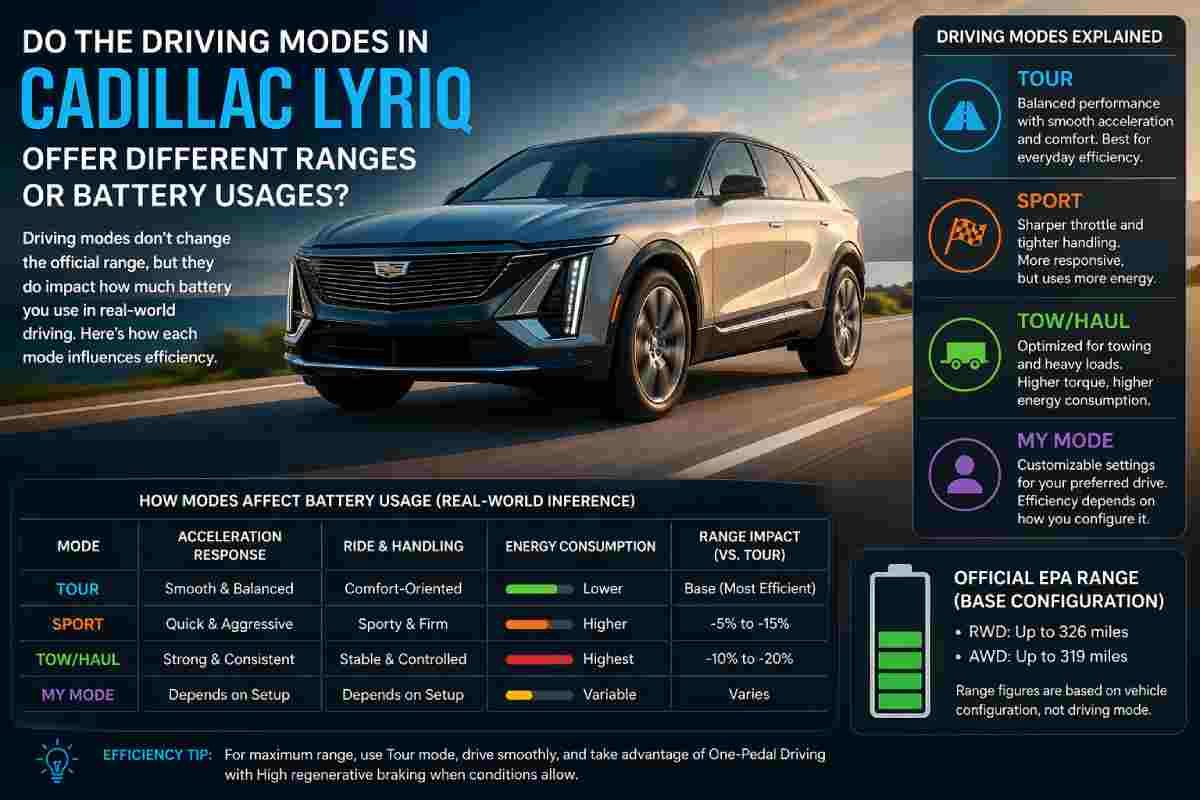
Do the Driving Modes in Cadillac Lyriq Offer Different Ranges or Battery Usages? – The simple answer is yes, but they are included in an overall driving-reality energy consumption rather than having their own specific EPA numbers released for each. Rather, Cadillac releases range per powertrain; the RWD version is listed as having 326 miles EPA-estimated range and the AWD version with standard 11.5kW charging is listed at 319 miles EPA-estimated range.
The significance is that the concept is distinct from battery size and range rating. A mode changes how the vehicle feels and responds, while the battery pack and drivetrain determine the published range figure. In other words, the mode can influence how quickly you spend energy, but it does not create a separate official “Sport range” or “Tour range.”
Table of Contents
What Driving Modes Mean in the Cadillac LYRIQ
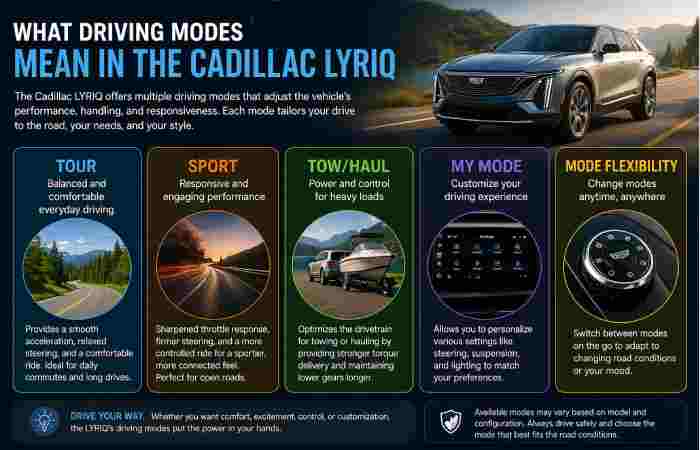
Driver Mode Control is Cadillac’s way of letting you tailor the LYRIQ’s performance to road conditions and driving preferences. Cadillac says the exact modes offered vary with the model and equipment, and are switchable while driving.
In essence, the LYRIQ modes focus on behavior- responsiveness, the stiffness or softness of the ride, and the handling in different driving conditions. One mode might feel efficient on a day-to-day basis while another feels more lively, though it uses a bit more battery power. That second part is an informed inference based on the mode descriptions and EV driving behaviour, not a published Cadillac range chart. Explore Cadillac LYRIQ Features & Range
Comparison Table: LYRIQ Driving Modes and Battery Impact
| Mode | What Cadillac says it does | Likely effect on battery use | Best use case |
| Tour | Normal acceleration and comfortable ride tuning for everyday driving. | Usually the most balanced setting for daily efficiency. | City driving, commuting, long relaxed drives |
| Sport | Tightened steering response and more responsive suspension calibration for a sporty feel. | Often uses more energy in practice because sharper response encourages stronger acceleration. This is an inference from the mode’s purpose. | Open roads, spirited driving |
| Tow/Haul | Keeps the vehicle in a lower gear for more torque and holds lower gears longer to reduce excessive shifting. | Can increase energy use compared with Tour because it prioritizes pulling power over efficiency. This is an inference from Cadillac’s description. | Towing, heavy loads |
| My Mode | Lets you personalize the drive by adjusting selected subsystems. | Battery impact depends on how you customize it. A calm setup may be efficient; an aggressive setup may use more power. Inference based on customization. | Drivers who want a custom feel |
The Real Answer: Do Modes Change Range?
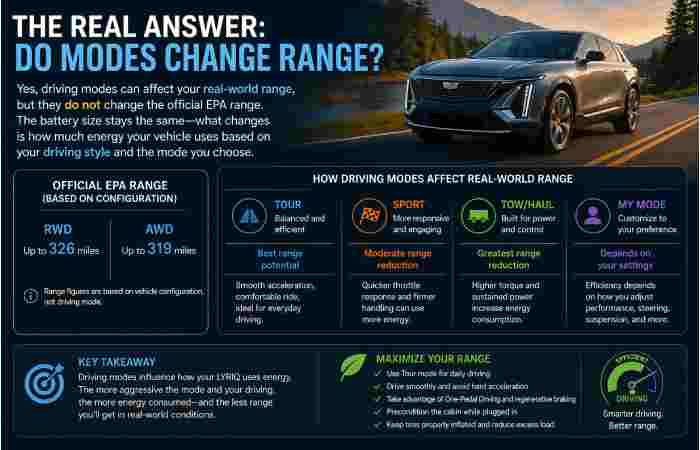
Yes, but mostly in the real-world sense, not in the official brochure sense.
If you drive in Tour, accelerate gently, and use regenerative features well, you will usually stretch the battery farther than if you drive in Sport and keep asking for strong bursts of power. That is because EVs spend more energy when they deliver quicker acceleration and more aggressive responses. Cadillac’s own descriptions point in that direction: Tour is framed as everyday comfort, while Sport is built for a tighter and more responsive feel.
But Cadillac does not give a separate official range number for each driving mode. The published range figures are tied to the LYRIQ’s configuration, not to whether you selected Tour or Sport on a given day.
So the clean way to say it is this:
Driving modes influence battery consumption; they do not change the official rated range.
One-Pedal Driving and Why It Matters
One of the biggest efficiency assistance for EV owners is One-Pedal Driving. Cadillac explains that, under normal driving conditions, you are able to accelerate and decelerate to a stop with only the accelerator pedal. There are On/Normal, High, and Off settings, with the High setting actually making the car decelerate faster when you take your foot off the accelerator.
This is helpful in this case because regenerative braking captures some of the energy you use during deceleration. Although Cadillac doesn’t come out and explicitly state, “this will increase your range by X amount of miles,” the point is that they market it as an efficiency-saving feature, and in real world conditions, this does help with a smoother, more efficient driving style.
There is one minor caveat, though. Cadillac recommends NOT using One-Pedal Driving in slick road conditions, such as on wet, snowy or icy surfaces. This is again, primarily more about control than range.
Which Mode Is Most Efficient?
Tour mode is the most reliable of the standard modes if you want to cover the maximum distance on a charge. Cadillac has labelled it the default, everyday, comfort mode, and if the gentlest response of the throttle usually corresponds to the least demanding way to drive, then the least demanding way to drive generally corresponds to maximum range.
It’s a reasonable assumption, and it lines up with how Cadillac positions the mode. My Mode can be an economical mode as well; you have to set it up that way. My Mode is adjustable in subsystems; it can be tailored for maximum smoothness or the opposite.
Sport is the mode most likely to reduce range slightly in real-world use, not because it “drains the battery” by itself, but because it encourages more responsive acceleration and a firmer driving feel. That usually leads to higher energy use.
Tow/Haul. The least efficiency-conscious setting in this selection. This setting is intended to provide assistance while you’re towing or hauling a heavier load. And, when a vehicle is working harder, energy usage tends to increase.
So What Exactly Changes the LYRIQ’s Battery Consumption?
The core factors remain: acceleration effort, speed, frequency of braking, use of the climate control system and additional payload. The mode can influence those choices, but it is not the only reason the range goes up or down. Cadillac’s range numbers are published for the vehicle configuration, while the mode system is there to tune the driving experience.
That is why two LYRIQs with the same trim can behave differently on the road. A driver who stays in Tour, uses One-Pedal Driving smoothly, and avoids aggressive acceleration will typically see better battery results than someone who stays in Sport and drives harder. That conclusion is an inference from Cadillac’s official mode descriptions and One-Pedal Driving guidance.
A Simple Way to Think About It
Think of the LYRIQ’s modes like different moods for the same luxury EV:
Tour is the calm, polished daily setting. Sport is the sharper, more eager setting. Tow/Haul is the work-focused setting. My Mode is the personal setting. None of them changes the battery itself, but each one changes how the car asks for energy and how you, as the driver, tend to use that energy.
That is the heart of the answer. The LYRIQ’s driving modes are not separate range packages. They are behavior packages. And behavior affects battery usage.
Final Verdict
So, do the driving modes in Cadillac LYRIQ offer different ranges or battery usages?
Yes, they can lead to different battery usage in the real world, especially when comparing calm driving in Tour with more aggressive use in Sport or Tow/Haul. But no, Cadillac does not publish separate official range figures for each mode. The advertised range is based on the LYRIQ’s configuration, not the selected drive mode.
If your goal is maximum range, the best everyday approach is usually a relaxed mode, gentle acceleration, and smart use of One-Pedal Driving. If your goal is a more exciting or heavy-duty feel, the LYRIQ gives you those modes, too, but they may cost a little more energy along the way